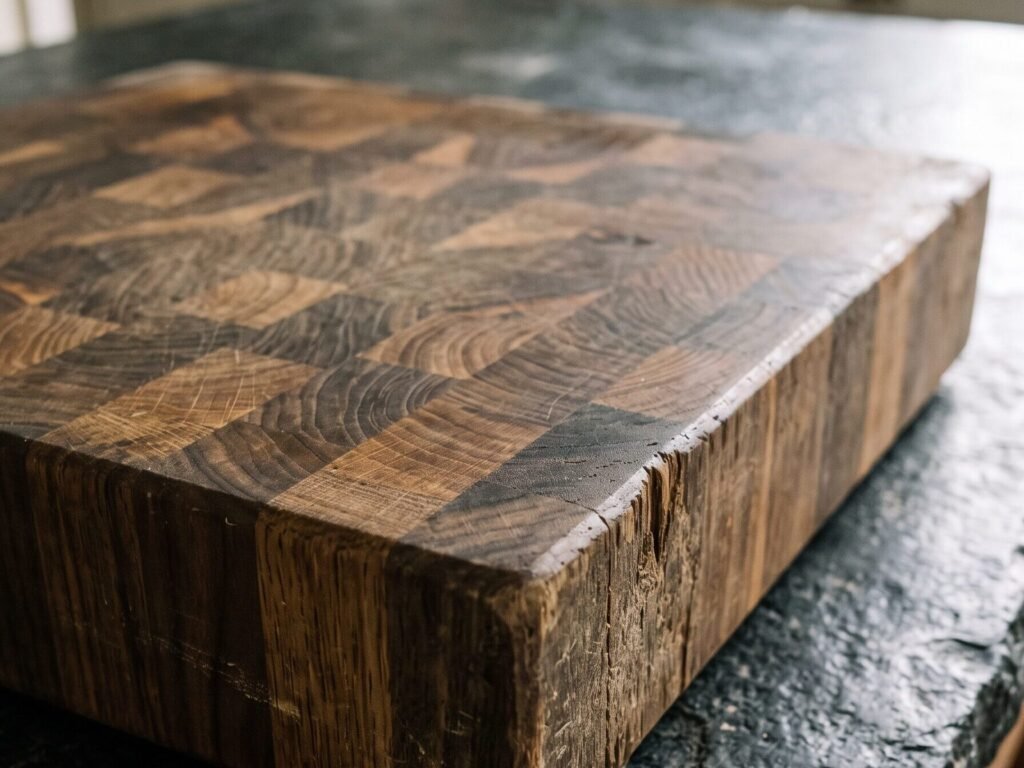
What the tree grew, the years wear in.
A wooden cutting board, a spoon, a bowl, a rolling pin: solid hardwood, cut and smoothed and left exactly as that shaping made it.
Nothing here was lacquered, stained, or sealed. A piece of living fiber arrives with one surface, the wood itself, and that surface is the only one it will ever have. What changes after that, the knife marks, the darkening where hands and heat keep landing, isn’t a finish wearing off. It’s the wood recording what’s been done to it.
This is one of the oldest kitchen materials there is, and people kept using it long after plastic arrived and long after they were told to stop. The reason is less about nostalgia than about what the material does under a knife.
On Wood and Bacteria
For decades the standard advice was that plastic boards are more sanitary than wooden ones. The research never quite backed that up. A 1994 study in the Journal of Food Protection tested new and used blocks of plastic and nine hardwoods, and its authors concluded the results did not support the idea that plastic is more sanitary. Bacteria from raw meat and poultry mostly couldn’t be recovered once they had soaked into the wood.
That’s reassuring, but it isn’t a free pass. These were small blocks, contaminated on purpose in a lab, not a board in a working kitchen, and the study measured bacteria, not illness. The fair reading is narrow: in lab tests, wood was not less sanitary than plastic. It doesn’t say wood kills bacteria, and we won’t claim it does.
On Oil
Most care guides tell you to oil a wooden cutting board on a schedule. One retailer’s guide suggests weekly for the first month, then monthly. The research is less sure of itself.
The same 1994 study found mineral oil on the surface had little effect on its results. A 2023 lab study in Coatings found that one coat of mineral or linseed oil left more bacteria recoverable from the surface than bare wood did. It used four wood species, two non-pathogenic stand-in strains and four replicates per condition, tested no waxes or commercial conditioners, and didn’t look at bacteria deeper in the wood.
Wood anatomist Seri Robinson argues in Fine Woodworking that no finish at all is best for anything that touches food. That’s an expert’s view, offered without data we could check. Cook’s Illustrated found that after twenty washes, utensils treated with spoon butter looked better than ones treated with straight mineral oil. That’s about appearance, not bacteria.
Our reading, and it is an inference: oil is a choice about looks and drying, not a hygiene step.
Where to Start
A reliable first board. Solid hardwood, simple, and priced so you can find out whether you like cooking this way before you spend real money.
A piece to keep. Made in small batches by someone who can tell you what the wood is and how it was joined. We haven’t verified any maker yet, so we’re not naming one.
There’s real disagreement online over whether a wooden board should be oiled at all, and how often.
On Glue and What Untreated Means
By untreated we mean solid hardwood with no film finish, no stain, and no sealant from the maker. What you do to it afterward is up to you.
Many boards are strips of hardwood laminated together, and we count those. Titebond III, a common glue for this, is described by its maker as FDA-compliant for indirect food contact. That’s the manufacturer’s statement, not an independent test. Fewer glue lines means fewer joints that can open, and Robinson recommends as few as possible. Bamboo is out, because it’s a grass, not a hardwood. So is anything lacquered, varnished, or polyurethane-coated, however natural it looks.
Choosing a Wooden Cutting Board
The honest choice is between a surface that forgives your knives and one that forgives your dishwasher. A wooden cutting board asks to be washed by hand and dried properly, and Robinson advises against soaking it or running it through the dishwasher. In return it’s gentler on an edge, and it shows its age without falling apart.
Pick wood if you’ll hand wash, accept the marks, and retire it when it cracks. Pick plastic if you need the dishwasher, or want one cheap board kept only for raw meat. They aren’t standing in for each other.
On Cracks
A crack in wood doesn’t heal the way rust reverses on iron. Online advice splits: some pages say food-safe glue or epoxy repairs it, others say most cracks mean the board should go, with an exception for hairlines. We found no study testing whether a repaired crack stays hygienic, so there’s no tested answer yet.
Our working rule, which is judgment and not a finding: retire a board whose crack is open, deep, or still traps food after cleaning. A hairline that stays tight is a closer call.
On Spoons and Spatulas
Food-safety experts quoted by HuffPost say cracked or damaged wooden spoons can trap bacteria more easily. The same rule applies as for boards: a spoon that’s cracked, splintering, or rough in a way washing doesn’t fix has done its work. Robinson’s view is that cooking spoons shouldn’t be finished at all. That’s her opinion, and we found no study that tests it.
On Bowls, Rolling Pins and Blocks
The same logic carries over to the rest of the wooden kitchen: salad bowls, rolling pins, butcher blocks. Solid hardwood, no film finish, washed by hand and dried before it’s put away. We haven’t found studies that test these pieces on their own, so we’re borrowing from the cutting board and spoon evidence and saying so. As we publish them, each one gets its own page.
On a Life of Use
A well-kept wooden board doesn’t really have a lifespan. It has a record. The shallow grooves where the knife always lands, the one corner that’s darker than the rest. They’re not flaws to sand away. They’re proof that someone cooked here, which is why a piece like this tends to be passed down until it finally splits.