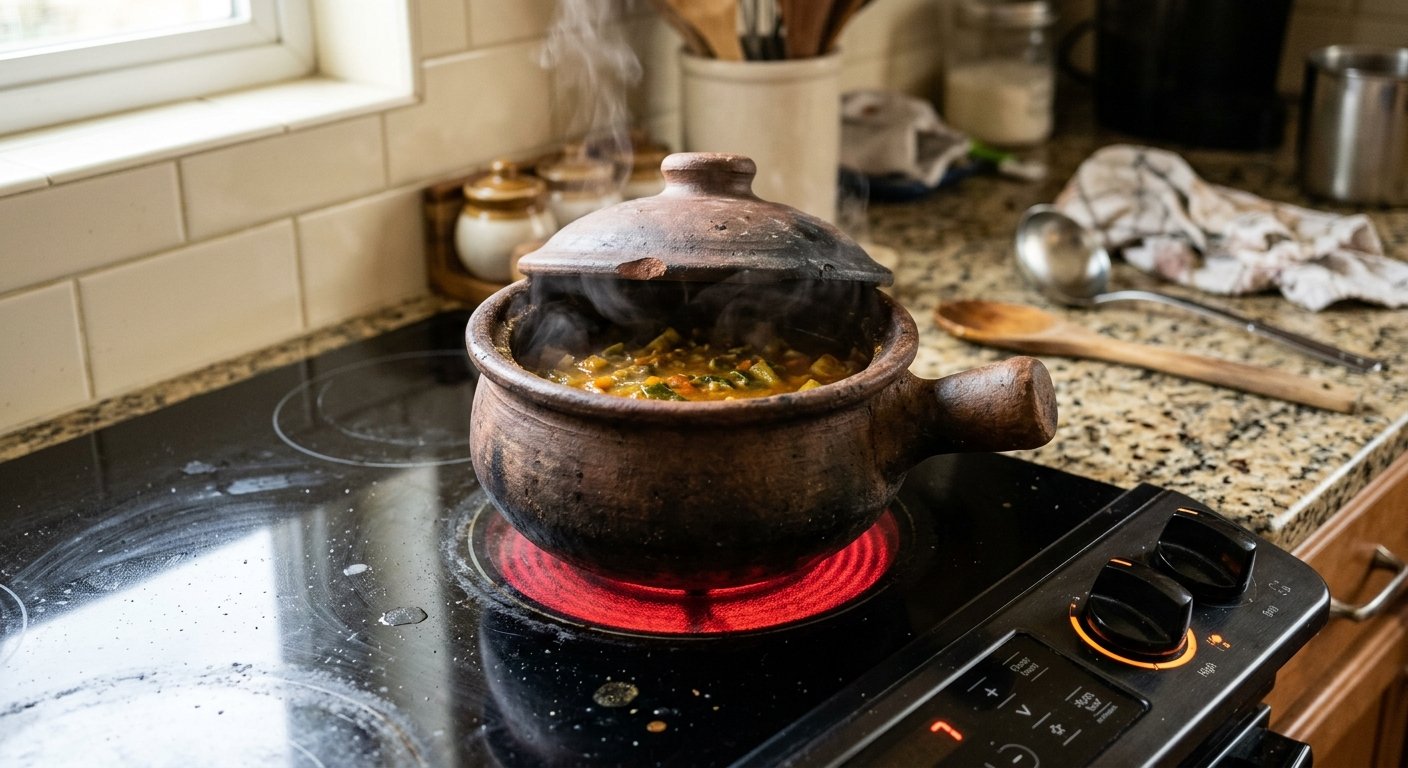
Clay Pot on Electric Stove: What the Makers Actually Say
Short answer: Putting a clay pot on electric stove burners works for some pots and ruins others, and the makers don’t agree on which is which. A Römertopf-style baker is oven only. A traditional Japanese donabe is usually made for open flame, and sellers split on electric. Flameware is built for it. No instructions? Don’t assume the pot is stovetop-safe. If you try it anyway, use the lowest heat, a dry base and liquid inside, and never heat it empty.
This guide is about clay pots for cooking, not garden planters. It covers electric coil, glass-top and induction stoves. For more on unglazed clay and stoneware cookware, see the full collection.
Glass tops add a second worry. It isn’t only the pot that can get damaged. Cooktop makers warn about the glass too, and most guides skip that part. You’ll find it further down.
Find your pot first
What you own changes the answer more than the stove does, so start there. Find your pot in the left column, then read across.
| Your pot | Coil burner | Glass or ceramic top | Induction |
|---|---|---|---|
| Römertopf-style baker | No. Oven only. | No. Oven only. | No. Oven only. |
| Standard donabe | Makers split | Makers split | No |
| Flameware | Yes | Yes | Only with a metal plate or heat source |
| Pot made for induction | Follow its sheet | Follow its sheet | Yes, if its sheet says so |
| Unmarked pot | Unknown | Unknown | Treat as no |
A Römertopf-style baker, the lidded, brick-shaped kind, is an oven pot. Its care sheet says it may only be used in the oven and never on a heated range top or open flame.
The donabe row, though, is the one that causes arguments. Many donabe are designed for open flame, and the electric answer depends on the maker. Musubi Kiln says its standard donabe works on electric cooktops. Just One Cookbook, a Japanese pottery council and Clove Garden say it’s a poor fit or shouldn’t go on electric at all. On induction, however, nobody says a standard one works.
Flameware, by contrast, is a different clay body, made to take direct heat. Clay Coyote and Emile Henry both say theirs suits electric, and both say induction needs a plate or metal heat source between the pot and the hob. If your pot has no label at all, the next section is for you.
If your pot has no instructions
Maybe it was a gift, or a market find, or the paper got lost. First, don’t assume the pot is stovetop-safe. That’s because some clay pots are oven only, and an unmarked one gives you no way to tell. If you decide to try an unmarked clay pot on electric stove heat anyway, start with your cooktop manual and look for anything about pottery or items placed under a pot. Then use the lowest heat and let it climb slowly. Next, wipe the base dry before it touches a hot surface, and keep liquid in the pot. Never heat it empty.
Also, if you have a glass top, skip the diffuser unless your cooktop’s maker says it’s fine. And if you have another option, use it. A baker belongs in the oven. For a donabe, Clove Garden suggests a portable butane stove when the only stove you have is electric.
Clay pot on electric stove: coil, glass top or induction?
Coil burners
Musubi Kiln says its standard donabe works on electric cooktops. Terra Klay says to use a diffuser and the smallest burner. Clove Garden says keep it off electric coils. None of the sheets gives a temperature for coil burners. Still, they do share one thing: low heat that climbs slowly.
Glass and ceramic tops
Glass tops are where the advice is least consistent, because pot makers and cooktop makers give different instructions.
On the pot side, Terra Klay says use a diffuser, and Just One Cookbook says don’t. On the cooktop side, GE manuals for radiant glass-ceramic tops list stoneware as not recommended: poor performance, and it may scratch. They also tell you to follow the cookware maker’s advice. A Whirlpool manual says only certain earthenware and glazed utensils suit a cooktop without breaking when the temperature changes fast.
Then there’s the diffuser question. A Jenn-Air manual says no wire trivets, fire rings, pads “or any such item” between the pot and the element. An Amana manual says a trivet or wok ring can mark or etch the top. Neither one names a heat diffuser. Still, a diffuser sits close to that list, so ask your cooktop’s maker before you put one on glass.
These are specific, older manuals, so they can’t speak for every cooktop. Yours is the one that counts.
Induction
A standard clay pot won’t work on induction. Musubi Kiln and Nagatani-en both say so. Pots made for induction are a different story. Nagatani-en’s induction line has a heating element built into the pot. It needs water inside before you heat it, and it’s made for cooktops sold in Japan only. Musubi Kiln lists three of its own models as induction-compatible.
The habits every maker agrees on
The makers split on the stove itself, but on how to heat a pot they mostly agree.
Go slowly. Musubi Kiln says to heat and cool gradually, at medium-low to medium and never too high. The Japanese pottery council says to start on low heat. Terra Klay warns against taking a pot from the fridge straight to the stove.
Dry the base first. Toiro says a wet base can soak up moisture that expands in the porous clay and may crack it, and Marui and Nagatani-en say the same about heating a wet pot. That’s about the base, not about soaking. Makers disagree on soaking, and we cover that in how long to soak terracotta pots.
Keep liquid in it. Musubi Kiln says never put it on direct heat without liquid, and Marui says an empty pot may warp, break or catch fire. There’s one exception, though: Nagatani-en says its dry-heat-safe donabe can go without liquid, so check yours.
And avoid shocks. Marui says don’t pour water on a hot pot or soak it, because rapid cooling may crack it. Likewise, the Japanese pottery council says a warm pot should never go straight somewhere cold.
If a pot does crack, here’s how to fix a cracked clay pot.
What each maker says
This is where the advice above comes from, and it shows why a one-line rule never fits. Tasting Table quoted a cookbook author in August 2026 who says clay and pottery cookware is “by design not meant for a stovetop.” Yet the makers’ own sheets are less simple. A flat rule for a clay pot on electric stove burners is wrong in both directions.
Oven only or open flame only
These voices are the clearest. The Römertopf sheet, an undated copy hosted on a US university site, says oven only, and to start in a cold oven. Clove Garden, written by Andrew Grygus, says a traditional donabe is open flame only, not electric coils. The Japanese pottery council‘s site, yakimono.or.jp, says donabe aren’t recommended on electric stoves because the heat is too intense. Just One Cookbook, a seller page with no named author, says most traditional donabe aren’t compatible with electric stoves, glass tops included. It adds that you can heat one on electric, but it doesn’t recommend a diffuser.
Yes, with care
These voices are fewer. Terra Klay‘s care sheet, which names no maker and no date, says to use a diffuser on an electric or ceramic stove. Musubi Kiln‘s help centre, updated 13 February 2026, says its standard donabe suits open-flame cooktops, electric ovens and electric cooktops, but not induction. In reader comments between December 2025 and February 2026, the company said one of its donabe will work on a smooth electric stove. A reader asked about a coil-type stove, and the reply didn’t address coils. A glass-or-ceramic question, though, was passed to email.
Pots built for electric
Then there are the pots made for it. Clay Coyote, a US pottery, wrote in 2010 (edited 2019) that its flameware works on gas, coil and glass tops, and that a diffuser is optional. That’s flameware, not unglazed earthenware. Emile Henry says its Flame range works with gas, electric and halogen, and with an induction plate on induction. Its ordinary ceramic bakeware, it adds, isn’t meant for direct flame or hot plates.
Makers who say nothing
Two makers stay quiet. Marui‘s manual says its donabe is “for open flames” and says nothing about electric. Nagatani-en‘s FAQ says donabe work with an open flame, radiant heater or super radiant heater, but it never names coil or glass-top stoves. Silence isn’t a yes.
The verdict on clay pot on electric stove
There’s no single rule, so don’t trust anyone who gives you one. Your pot’s maker decides. If the sheet says open flame only, believe it. If it allows electric, then go slowly, keep the base dry and keep liquid inside. On glass, check your cooktop manual before adding a diffuser. On induction, use only a pot made for induction.
Next up: how long to soak terracotta pots and how to fix a cracked clay pot. Browse everything we’ve published on unglazed clay and stoneware cookware.