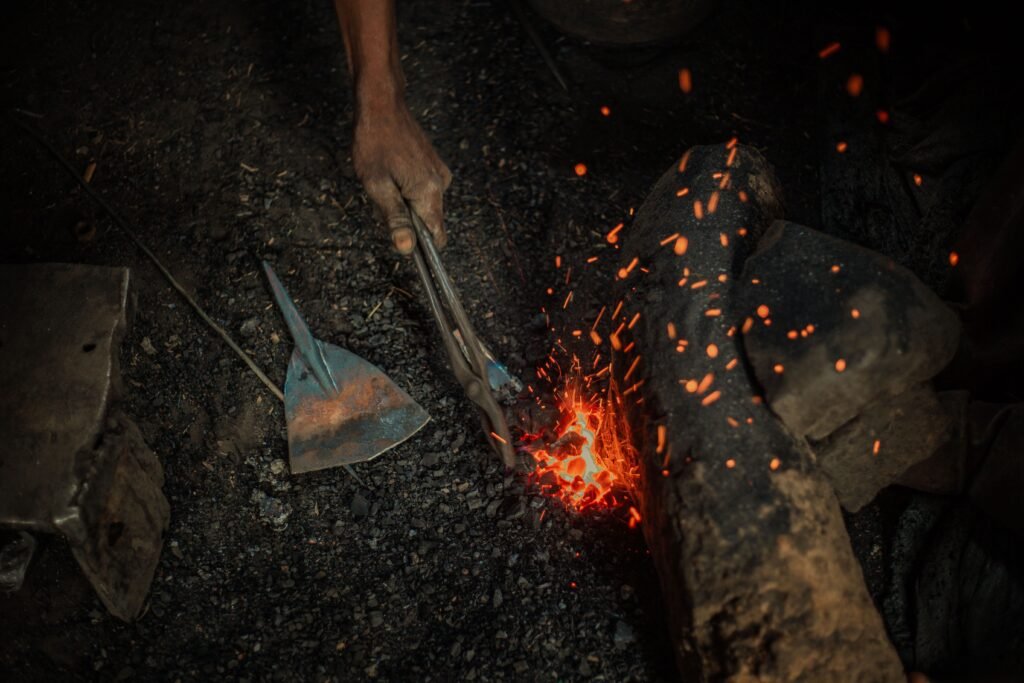
What heat and earth give, the years continue.
Cast iron poured in sand, carbon steel struck at the forge, both left exactly as that shaping made them.
Nothing here was dipped, sprayed, or lined. A ferrous object arrives with one surface, however it was made, and that surface is the only one it will ever have. What changes after that is the deepening color, the sheen that builds over months of oil and heat, isn’t a coating being applied. It’s the metal recording what’s been done to it.
This is the oldest cooking tool still in daily use, and the reason has nothing to do with nostalgia. Iron holds heat the way a stone wall holds the sun rays after a long day. It rewards patience and punishes shortcuts. Both of those are good things.
On Heat and Coatings
Most non-stick pans are coated in PTFE, sold for years under the name Teflon. The problem was never just the chemical used to make it. The coating itself is fragile in ways you can’t see until it fails. It starts to break down above about 260°C, or 500°F, releasing fumes that have long been known to kill pet birds. A 2022 study from Newcastle and Flinders Universities found that one small crack in a Teflon surface can release around 9,100 tiny plastic particles. A more badly broken coating can release as many as 2.3 million microplastics and nano plastics, measured right in the food.
For years, makers also used a separate chemical called PFOA to produce PTFE coatings. In December 2023, the International Agency for Research on Cancer, the WHO’s cancer agency, classified PFOA as a Group 1 carcinogen. That’s the same category as asbestos. The classification rests on strong evidence from animal studies and clear signs of harm in exposed humans. US manufacturers had already agreed to phase PFOA out of production by 2015, which is why most pans sold today carry a “PFOA-free” label. That label answers one question. It leaves the coating itself, and what happens when it cracks, untouched.
None of this needs an alarmed tone to be worth knowing. It’s simply why a coated pan comes with a list of rules that a piece of solid iron never needed. There’s nothing layered onto cast iron for you to worry about.
| Where to Start |
|---|
| A reliable first pan. Pre-seasoned and mass-produced. A good choice before you know if this way of cooking suits you. |
| A piece to keep. Hand-poured or hand-finished, made in small batches by someone who still does this by hand. The kind of pan you’d still want in twenty years. |
There’s real disagreement online about which oil actually builds the seasoning that holds up longest
On Weight
A light pan is a pan built to ship cheaply, not to hold its heat. Cast iron is actually a poor conductor of heat compared to aluminum or copper. Left alone, it runs hotter right over the flame than it does at the edges. What its weight gives you instead is thermal mass. Once that much iron is hot, a cold piece of meat can’t pull its temperature back down. The weight isn’t the price you pay for quality. It’s what makes a proper sear possible at all.
Cast Iron and Carbon Steel
Both are iron, just shaped in different ways. Cast iron is poured into its final shape and stays that way for generations, holding heat through anything you set on top of it. Carbon steel is hammered thinner and lighter, and it answers the flame in seconds instead of minutes. Neither one replaces the other. The real choice is between staying power and speed. Pick cast iron for a long, hard sear. Pick carbon steel for a pan you want to tilt and toss.
On Rust and Repair
Rust is not damage. It’s just iron slowly returning to the ore it came from, and it’s almost always reversible with steel wool, heat, and oil. A coated pan can rarely say the same once its coating fails.
On a Life of Use
A well-kept pan doesn’t really have a lifespan. It has a story. The uneven patina, the one corner that always heats a little darker than the rest, these aren’t flaws to sand away. They’re proof that someone actually used the thing, which is why a piece like this tends to get passed down rather than thrown out.
Published Studies
-
Cast Iron or Carbon Steel: Which Should You Choose?
Ask ten people why cast iron beats carbon steel and you’ll hear the same three claims, delivered with total confidence and zero evidence behind any of them:…